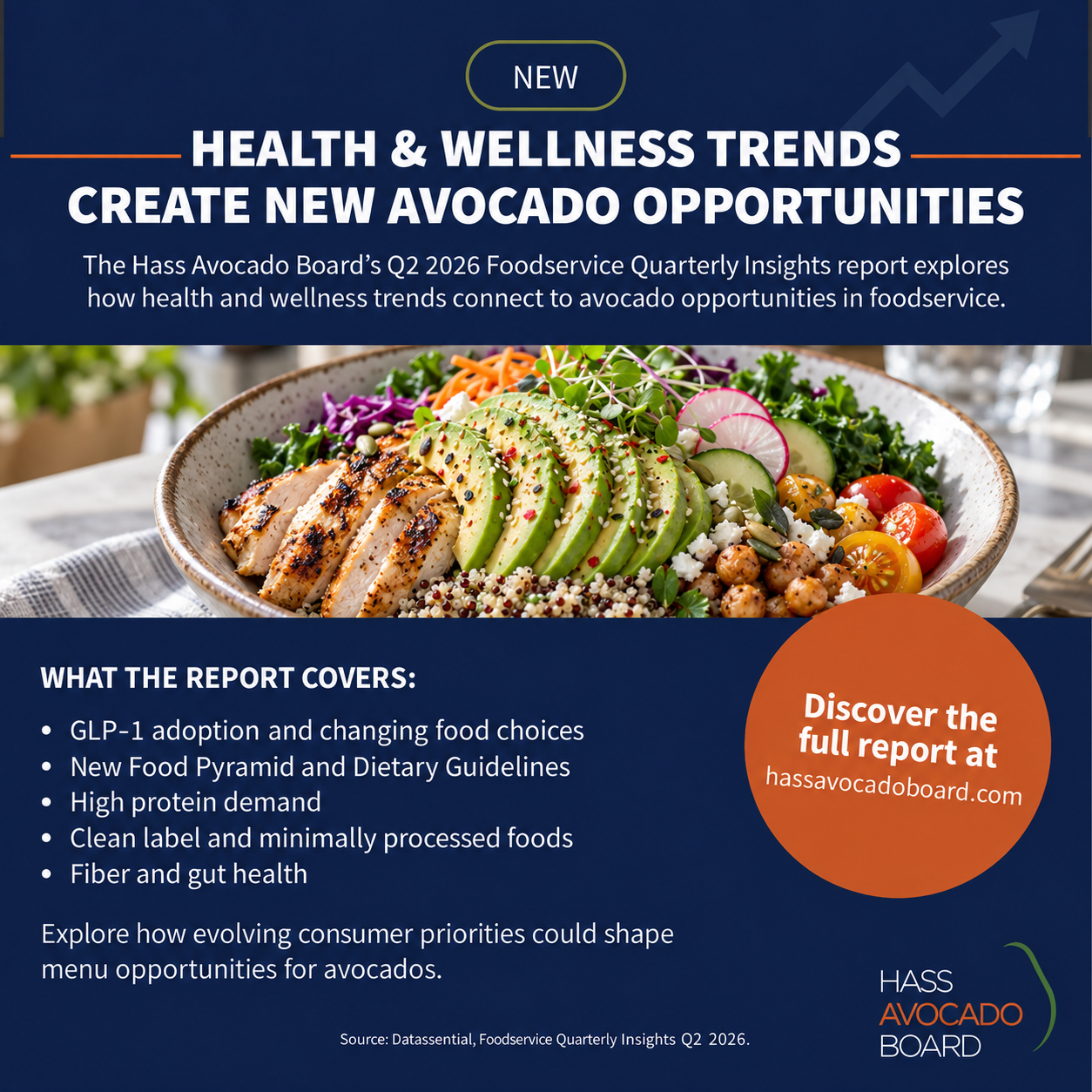
MISSION VIEJO, Calif. (September 23, 2026) — The Hass Avocado Board (HAB) has released its latest Foodservice Quarterly Insights report, exploring how health and wellness trends are reshaping what consumers look for in food and what those shifts could mean for avocados in foodservice. Developed in partnership with Datassential, the second quarter 2026 report examines GLP-1 adoption, new dietary guidance, high-protein and nutrient-dense demand, clean label, changing wellness priorities, seed-oil alternatives, and growing interest in fiber and gut health.
Across these trends, consumers are showing greater interest in fresh, whole, and simple foods, while operators continue to adapt menus and messaging. The report connects these broader shifts back to avocados, providing the industry with context on where the category naturally fits and where potential foodservice opportunities may be emerging.
Key health and wellness findings include:
- GLP-1 use is influencing food choices. Eleven percent of consumers currently use a GLP-1, and another 27% are interested. Among users, consumption of fresh fruit increased 41%, and vegetable consumption increased 20%, while consumption of sugary, fried, and fatty foods declined.
- Consumers are responding to new federal food guidance faster than operators, a notable finding given avocado’s inclusion in the 2025-2030 Dietary Guidelines graphic. Fifty-eight percent of consumers say they plan to make dietary changes, compared with 48% of operators who plan menu changes.
- High-protein eating is firmly established, with 89% of consumers familiar with the term, 79% having tried high-protein foods, and 65% saying they love or like them. The report highlights avocado as a natural pairing with protein-forward bowls, salads, and sandwiches rather than as a protein source itself.
- Fiber and gut health are gaining momentum, but menus have not kept pace with consumer interest. Prebiotic menu penetration increased from 0.06% in 2020 to 0.25% in 2026, narrowing the gap with probiotic mentions at 0.44%. This creates an opportunity for operators to communicate the fiber provided by avocados more clearly on menus.
“Health and wellness conversations are changing quickly, and the value of this report is that it brings those shifts back to the avocado category,” said Alejandro Gavito, director of business insights and data. “Whether the conversation is GLP-1s, protein, clean label, or avocado oil, the goal is to help the avocado supply chain understand where avocados fit and where there may be opportunities to strengthen their presence in foodservice.”
The report also examines clean label and minimally processed foods, broader wellness priorities, and the growing conversation around fiber and gut health. Across these areas, the findings show how avocados can be considered within evolving consumer expectations.
To explore the complete second quarter 2026 Foodservice Quarterly Insights report and additional findings, visit HassAvocadoBoard.com.
###
About The Hass Avocado Board
The Hass Avocado Board (HAB )’s job is to make avocados America’s preferred healthy food for every meal. HAB is the only avocado organization that equips the entire global industry for success by collecting, focusing, and distributing investments to maintain and expand demand for avocados in the United States. HAB provides the industry with consolidated supply and market data, conducts nutrition research, educates health professionals, and brings people together from all corners of the industry to collectively work towards growth that benefits everyone. The organization also collects and reallocates funds to California and importer associations to benefit specific countries of origin in promoting their avocado brands to customers and consumers across the United States.